
Why AI Tools Won’t Transform Estate Agency Until the Business Model Changes
AI is making estate agents faster, but not necessarily more profitable. Real transformation will come when agencies redesign their business around AI — not just add new tools.
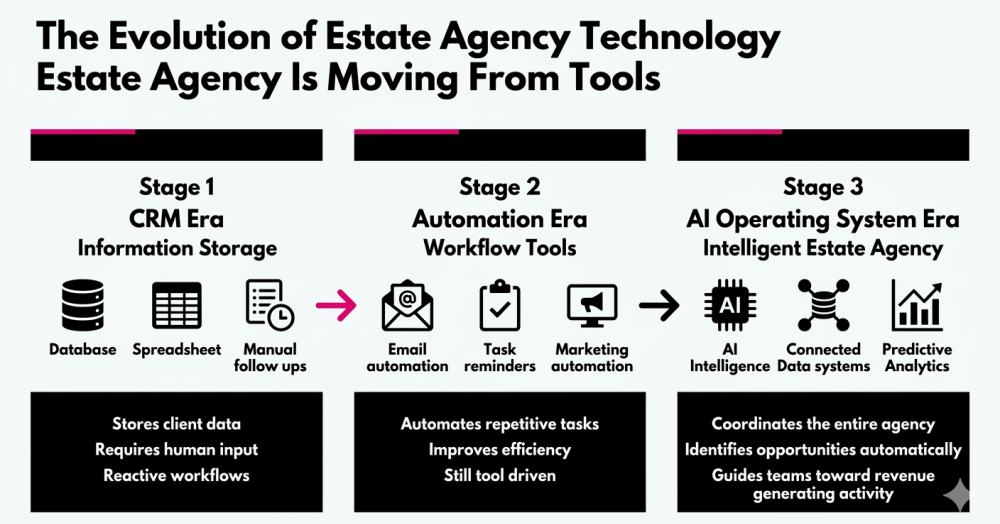
For the past two years, artificial intelligence has dominated conversations across the business world. Estate agency is no exception. From AI-written property descriptions to automated marketing and chatbots, the industry now has access to technology that can dramatically increase individual productivity.
But there’s a problem.
Despite the rise of AI tools, most estate agencies are not seeing a dramatic improvement in profitability or efficiency.
Why?
Because technology alone does not transform businesses.
History shows us that real productivity gains only occur when organisations redesign themselves around new technology.
A powerful example comes from the early days of electrification in the late 1800s. Factories replaced steam engines with electric motors, expecting productivity to skyrocket. Instead, output barely changed for decades.
The reason was simple: factories had swapped the motor but kept the same factory design.
Steam-powered factories were built around large central driveshafts that distributed power across the building.
Electric motors made that system obsolete, but most factories continued operating the same way.
Only when factories redesigned themselves — introducing assembly lines, distributed motors, and new workflows — did productivity surge.
Estate agency is now experiencing a similar moment with AI.
Many agencies are adding AI tools into their existing systems. They might use ChatGPT to write property descriptions, automate social media posts, or analyse market data faster.
But the structure of the business remains the same.
Agents are still juggling disconnected systems:
CRM platforms
portal enquiries
email marketing tools
spreadsheets
manual follow-up processes
Each system generates activity, but none of them coordinate the business as a whole.
Not only this but the AI tools are being shoe horned into peoples existing jobs, making them an add on rather than something people can truly master.
This is where the next evolution of AI will emerge.
The future of estate agency will not be defined by individual productivity tools, but by AI-powered systems that coordinate the entire organisation.
Think of it as an AI operating system for the agency.
Instead of simply helping agents work faster, these systems focus on orchestrating the business itself. They connect data across marketing, prospecting, CRM activity, and client communication to identify the most valuable opportunities.
The goal is not just to save time. It is to generate revenue.
Artificial intelligence can analyse behaviour patterns that humans would struggle to track manually. For example, systems can identify homeowners engaging with property content, detect buyers who also own property locally, or highlight vendors whose listings may be at risk of falling through. These signals allow agents to focus their time on the conversations that actually lead to instructions but to do so will require a complete rewiring of the job roles and the working day.
In other words, the role of AI is shifting from automation to orchestration.
The agencies that thrive in the coming decade will be those that redesign their processes around this new capability.
They will use AI to coordinate marketing, prospecting, and client communication in a unified system. Administrative work will be reduced, opportunities will be surfaced earlier, and agents will spend more of their time building relationships and closing deals.
The lesson from history is clear.
Electricity didn’t transform factories until the factories were redesigned.
Artificial intelligence will not transform estate agency until agencies redesign themselves around it.
The technology is already here.
Now it’s time to rethink the way the business works.
Book a call
Unlock the transformative power of our AI Operating System for Estate Agents. Designed to replace an agents prospecting tools, CRM, marketing tools, compliance tools and even their website in order to future proof their business and increase profit.
First Name*
Last Name*
Email*
Phone*
Company*
Which best describes your estate agency?
Are you the final decision maker for technology and strategic investments in your company?
Affordability-We understand it is our job to show you the measurable ROI value Iceberg’s solutions can bring to your agency. The investment starts from £1,399 per month. If you did see the benefit of our platform, is this affordable?
Any other information
Please confirm that it is okay for us to contact you about this information as well as our products and services. By confirming, you also agree to the use of cookies to enhance your experience. (You will always have the right to unsubscribe or manage your cookie preferences at any point in the future.)*
Latest news

The End of “AI Features” — Introducing the Brain
Every CRM is adding AI right now. On the surface, it looks like progress but underneath, very little has actually changed. Now something new is entering the market and it is changing the entire operating system of Estate Agency.
Read more

Why Traditional Estate Agency CRM Software Is No Longer Enough for Modern UK Agencies
Are you still relying on traditional CRM software to drive your estate agency forward? Many agents are discovering that these systems, while functional, simply don't meet the demands of today's fast-paced market. It's time to explore why a new approach is essential.
Read more
Your CRM Remembers. But Does It Think?
Your CRM stores everything. But it doesn’t tell you what matters. While most agents stay busy chasing, a new breed is using systems that think, act, and surface opportunity — before the competition even knows it exists.
Read more